
Farmers obsess over feed. Housing and genetics usually get whatever budget is left over — a shed thrown up, and "an F1" bought because someone called it that.
But neither of those is a one-time cost you pay and forget. Both are a daily tax on every pig in the pen, whether you notice it or not.
💸 The Number Nobody Puts on Housing — or Genetics
Below is an illustrative breakdown of where poor housing design and poor genetics quietly eat into profit — per pig, every single cycle:
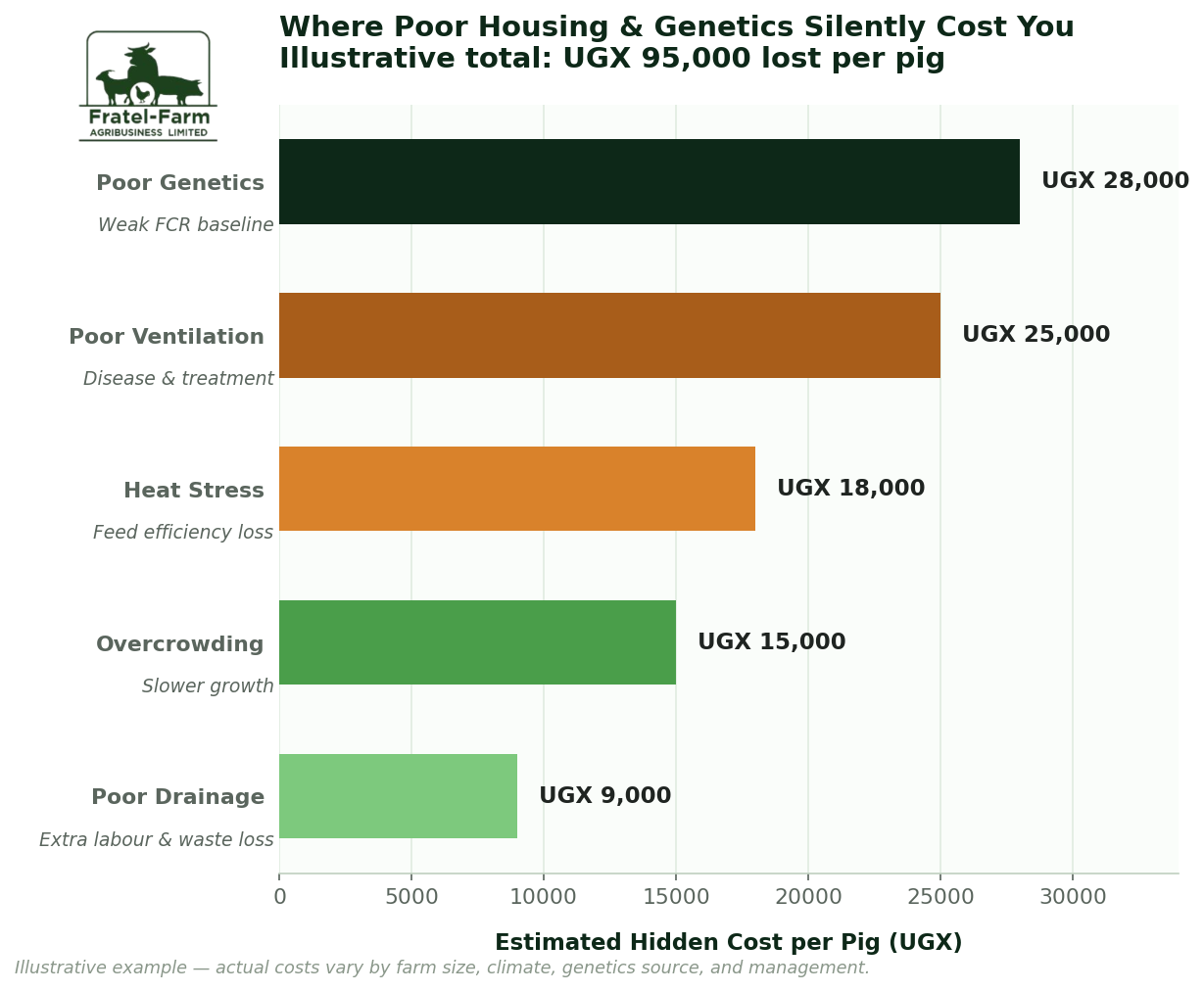
None of these show up as a single line item on your books. They hide inside "feed costs were higher than expected," "growth was slower than expected," or "we lost a few more piglets than usual." Housing and genetics are very often the real cause behind all three — and notice which one tops the chart.
🔍 Five Ways Housing & Genetics Quietly Drain Profit
A weak FCR baseline no housing can fix
As we covered in "F1 Is Not a Breed," not all F1s are equal — genetics selected for growth, feed efficiency, and litter performance set the ceiling on what your pig can achieve. Buy stock on a label alone, and even perfect housing is working against a weaker starting point.
You pay more feed for the same weight gain
Pigs under heat stress eat less but still need energy just to stay cool. As covered in Episode 2, feed conversion is already your tightest margin — heat stress makes it worse without you seeing it directly.
Ammonia buildup opens the door to disease
Stale, poorly circulated air raises ammonia levels, irritating pigs' lungs and lowering resistance to respiratory disease — the same disease pressure discussed in our ASF prevention article.
Stress slows growth, even with good feed
Cramped pens mean more fighting, more injuries, and chronic stress — all of which suppress growth even when nutrition is done right.
More labour, more disease-friendly conditions
Standing water and waste buildup mean more cleaning hours and a breeding ground for parasites and bacteria — a slow bleed on both labour cost and herd health.
We're Not Making These Numbers Up
The exact shilling figure per pig will always vary by farm size, feed price, and season — that's why we call the chart above "illustrative." But the direction and scale of each driver is grounded in published swine research, not guesswork:
- Genetics: Crossing improved boar lines onto local sows has been shown to lift size, feed conversion, and weight gain by around 10% through hybrid vigour — while genetics alone accounts for roughly 30% of a pig's total growth potential, with day-to-day management filling the rest.
- Heat stress: As temperatures approach 30°C, pigs can cut feed intake by more than 30%, and studies show daily weight gain can fall by roughly 35–40 grams for every 1°C above their comfort zone — exactly the range many Ugandan piggeries sit in without cooling or shade.
- Overcrowding: A production study spanning nearly 500,000 grow-finish pigs found pens holding more than 20 animals had measurably worse feed conversion than smaller pens — competition for feeder space and stress add up over a full cycle.
- Ventilation & drainage: Poor sanitation and stale air force a pig's body to spend energy fighting pathogens instead of gaining weight — a well-established driver of poor feed efficiency in swine nutrition research.
Research referenced: The Pig Site — pig growth rates in Africa · Springer — breeding strategies for African pig systems · The Pig Site — heat stress in pigs · Porcine Health Management — feed intake & FCR factors · Purina Animal Nutrition — factors affecting FCR. The percentage effects above come from these studies; the shilling-per-pig figures in the chart are Fratel Farm's own illustrative modeling based on typical Ugandan feed costs, not figures published in the studies themselves.
🏗️ The Copy-Paste Trap, Again
We've written before about how copy-paste farm structures cost farmers money — and it applies directly here. A design copied from a farm three times your size, or from a cooler climate, won't solve any of the four problems above. It might even cause them.
We Fix Both Ends — Housing and Genetics
Our farm structural design and breeding stock sourcing help you stop losing money on the two things that quietly set your farm's ceiling — before the pigs even arrive.
- Ventilation and layout designed for Uganda's climate, not copied from elsewhere
- Space allocation matched to your herd size and growth stage
- Drainage, waste management, and biosecurity-first design built in from day one
- Breeding stock sourced and matched to your actual production goals
Get Farming Tips Straight to Your Inbox
Join our list for practical farm advice, new "Reading the Pig" episodes, and updates from Fratel Farm. No spam, unsubscribe anytime.